The Quiet Diplomacy of the Programme Page
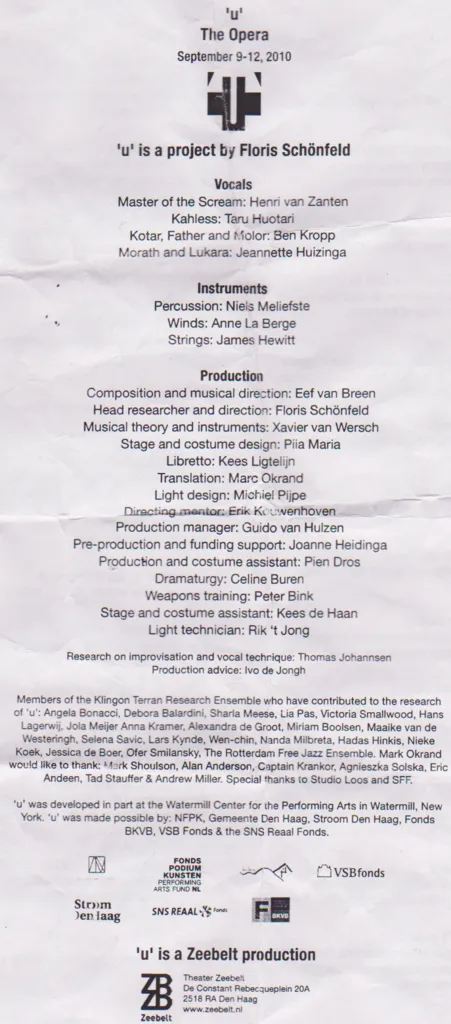
Photo: Floris Schönfeld (artistic director), Public domain, via Wikimedia Commons
There is a moment in every press campaign when a cast list stops being a list and becomes a negotiation. It usually happens late. The posters are nearly signed off, the website has been built, and someone sends round a PDF with names in a particular order. Within an hour, the emails begin. Not about money. Not about rehearsal rooms. About whether one name sits above another, whether an 'and' is doing enough work, whether 'with' sounds warmer than 'featuring'. If you have never been copied into that thread, count yourself fortunate. If you have, you will know that billing is never just typography.
The programme page is where all that quiet diplomacy lands. To an audience, it can look like a simple hierarchy: lead, co-lead, supporting company, creatives. To a company, it is a small constitution. It records who was engaged first, who carries the marketing, who has the longest history with the building and who has the best agent. It also records something less comfortable: who had the leverage to ask, and who did not.
The words that do the heavy lifting
'Above the title' is the phrase everyone knows and almost nobody explains. In practice, it means a performer's name appears before the show's title on the poster, often in a separate block, often with a photograph. It is a signal of marquee value — the kind of name a producer hopes will shift tickets before a review exists. It is not necessarily the biggest role. A star can be above the title for a limited run and still be onstage for twenty minutes. That is not a trick. It is the deal.
Then there is the 'and'. In billing, 'and' is not a conjunction; it is a small medal. It often goes to a senior performer who is not the lead but whose presence gives the company weight. 'With' is gentler. It suggests association rather than headline status, a way of acknowledging profile without claiming the top line. 'Featuring' can be even more modest, though in the wrong hands it sounds like a hotel breakfast. None of these words are neutral. Each one has been chosen, argued over and signed off.
Regional reps have their own grammar. A weekly rep in Sheffield or a mid-scale touring house in Norwich may not have a West End poster to worry about, but billing still matters. It matters to the actor who has spent fifteen years building a local following. It matters to the director who wants the company to look like an ensemble rather than a star vehicle. It matters to the box office, who know that some names sell in Leeds and others sell in Bristol. The programme page is a local document as much as a commercial one.
What audiences actually read
Theatre people often assume audiences skim the cast list. I am not convinced. Audiences read billing more closely than we give them credit for. They notice when a familiar name sits fifth from the top. They notice when a young actor is given an 'and' above the title after a television series. They notice when a beloved character actor is buried at the bottom of the page and they say, rightly, 'hang on, they were brilliant'. Billing is one of the few pieces of backstage information that reaches the public unfiltered. It is a clue, and people like clues.
That is why the order can feel like a truth claim even when it is not. A cast list is not a review. It is not a measure of stage time, difficulty or emotional labour. It is a record of an agreement. The person at the top may carry the show; the person halfway down may carry the audience's heart. The person with the 'and' may be the most generous company member in the building, or the most demanding, or both. You cannot tell from the page. You can only tell from the room.
I have seen billing handled beautifully. A producer once insisted that a young company member's name be moved up because she had been in the production from its first workshop. It was not a contractual obligation. It was a courtesy, and it changed the way the company felt about the whole job. I have also seen the opposite: a tiny preposition become a source of weeks of resentment. The words are small. The feelings are not.
When the order lies
Does the order ever tell the truth about who actually carries the show? Sometimes. In a star vehicle, the billing is honest: the name is the reason the tour exists. In an ensemble piece, the hierarchy can be almost meaningless. The actor with the smallest font may be the one holding the emotional centre. The actor above the title may be gone by the interval. The programme cannot capture that. It is a snapshot of negotiations, not a map of talent.
That is not a reason to dismiss billing. It is a reason to read it with a little more curiosity. When you next open a programme, look at the order. Look at the 'and' and the 'with'. Ask who is being honoured, who is being soothed and who is being asked to wait. Then watch the show and see whether the page matches the stage. Often it will. Often it will not. The gap between the two is where the real backstage story lives.
And if you are ever lucky enough to be in the room when the billing is agreed, bring patience. The cast list is not just a list. It is a group photograph taken with words, and everyone wants to be facing the right way.