Beyond 'Good With People': The Backstage Skill Worth Naming
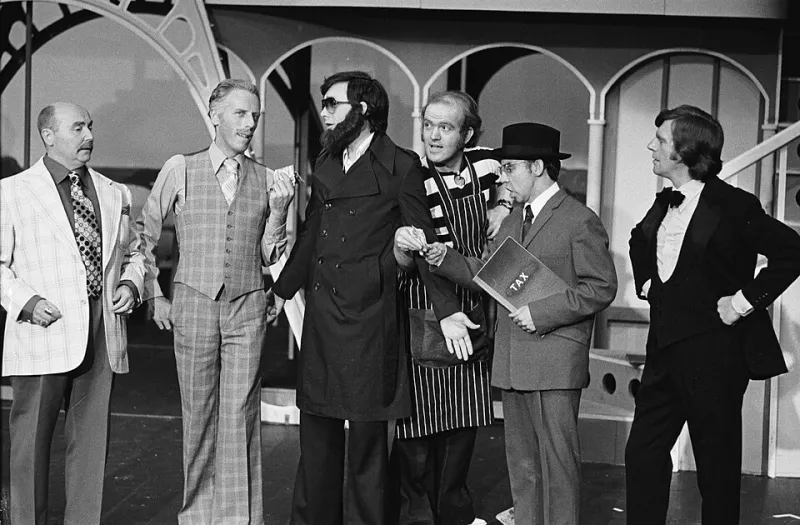
Photo: Geoff Charles, CC BY-SA 4.0, via Wikimedia Commons
There's a line on almost every creative CV that means nothing and everything: 'Excellent communication skills.' It sits there between 'proficient in Microsoft Office' and 'full clean driving licence', doing no harm and winning no interviews. And yet the thing it's trying to describe — the ability to hold a room — is one of the most valuable skills in live entertainment.
I don't mean the loud version. I mean the quiet work: warming up a crowd before the show, managing your own nerves so they don't become the audience's problem, reading a room that's one bad heckle away from turning, and keeping the green room from becoming a diplomatic incident. That's creative labour. It just doesn't look like a portfolio.
The work nobody puts in the job description
Holding the room is not a single skill. It's a cluster. It's the pre-show announcement that settles a restless audience. It's the way a company manager moves through the dressing room before a difficult matinee. It's the stage manager who notices the understudy is spiralling and quietly rearranges the coffee run so they get five minutes alone. It's the performer who can feel the front few rows losing interest and changes gear without dropping the script.
In a rehearsal room, we call it 'reading the room'. In a job application, we call it 'teamwork'. In reality, it's closer to emotional logistics.
What holding the room actually looks like
Here are a few examples I've seen in UK venues, the kind of thing that never makes it into a show report:
- A touring company arrives late because of traffic on the M6. The audience is already seated and getting fidgety. The front-of-house manager doesn't apologise over the tannoy like a hostage negotiation. They step into the bar, explain the delay, offer a free interval drink, and ask the audience to help themselves to programme notes. The room resets.
- A panto matinee has a school party in the front rows who are more interested in each other than the show. The dame clocks it, pulls a face, and makes them part of the joke. Suddenly they're watching. That's not luck. That's a skill.
- A green room after a mixed review. One performer wants to dissect every note. Another wants to pretend it didn't happen. The company manager reads the room, splits the difference, and gets everyone to the get-out without a row.
These aren't soft skills. They're operational skills with a human interface.
Why it vanishes when we write applications
We leave it off because it feels like boasting. We leave it off because the job advert asks for 'excellent interpersonal skills' and we think that means being nice. We leave it off because the industry has spent decades treating front-of-house and backstage diplomacy as something you either have or you don't, rather than something you practise.
But the people hiring know the difference between someone who is pleasant and someone who can hold a room. They just need you to show it.
Turn 'I'm good with people' into evidence
The trick is to stop describing yourself and start telling a story with a result. Not a fake result. A real one.
Instead of: 'I'm good with people.'
Try: 'At a mid-scale touring venue, I noticed the interval bar queue was causing a late second half. I worked with front of house to open a second till and pre-pour interval drinks. The second half started on time for the rest of the run.'
That's not a brag. That's a case study. It shows you can see a problem, work with another department, and measure the outcome.
Instead of: 'I can handle nerves.'
Try: 'Before a press night, a cast member had a panic attack in the wings. I stayed with them, got the stage manager involved, and made sure their entrance was covered. They went on. The show didn't stop.'
Again: context, action, result. You're not claiming to be a therapist. You're showing you can be a steady presence when it matters.
The five-minute room log
Here's an exercise I wish I'd been given years ago. After every show, gig, workshop or meeting, spend five minutes writing three lines:
- What was the room like when I arrived? Tired, wired, empty, full, hostile, flat?
- What did I do that changed it? Not what you felt. What you did.
- What happened next? Did the audience settle? Did the meeting move? Did the get-out finish on time?
Do that for a month and you'll have a bank of evidence. You'll also start to notice patterns: the pre-show announcement that always works, the green-room question that always defuses a row, the moment when you need to stop talking and open the door.
In the interview, say the quiet part out loud
When someone asks about your experience, don't just list the credits. Tell them about the room. 'The show was fine, but the audience was tricky' is a more useful sentence than 'I have excellent communication skills'. It invites a follow-up. It shows you understand that live entertainment is not a solo art form.
And if you're the one hiring, ask the question directly: 'Tell me about a time you changed the temperature of a room.' You'll learn more about a candidate in two minutes than from a whole page of adjectives.
The bottom line
Holding the room is not a personality trait. It's a craft. It deserves a line on your CV, a bullet in your application, and a proper conversation in the interview. The industry runs on it. The least we can do is name it.