Please, Keep Your Seat: The Case for Applauding Honestly
The first person to stand
There is a particular sound a theatre makes when an audience decides to stand. It is not quite applause and not quite movement. It is the rustle of coats, the creak of seats, the shuffle of feet, and then a wave of noise that rolls towards the stage like weather. I have heard it on a wet Tuesday in Leeds and on a Saturday night in the West End, and I have increasingly come to think that we are getting it wrong.
Not always. Not everywhere. But often enough that the standing ovation has stopped being a response and started being a reflex. You can feel it in the room before it happens. The play ends. The lights come up on the company. Someone in row F decides that this is the moment, and everyone else has to choose: stand too, or sit there like the person who did not laugh at the joke.
The group project nobody signed up for
British audiences are, by and large, a polite bunch. We clap when we are told. We laugh at the panto. We queue for the loo in the interval without making a fuss. We are also deeply susceptible to the fear of being the odd one out. A standing ovation is a group decision disguised as a spontaneous one. The first person stands, the second person stands because the first person stood, and by the third row it is no longer about the show. It is about belonging.
Social media has not helped. A curtain call is now content. People film the ovation for their stories, and an audience that stays seated does not make the same clip as an audience that rises. There is pressure to perform appreciation, not just feel it. The result is a kind of ovation inflation: the meaning of the gesture has been diluted by how often we use it. If every show gets a standing ovation, what is left for the shows that actually deserve one?
What the stage can see
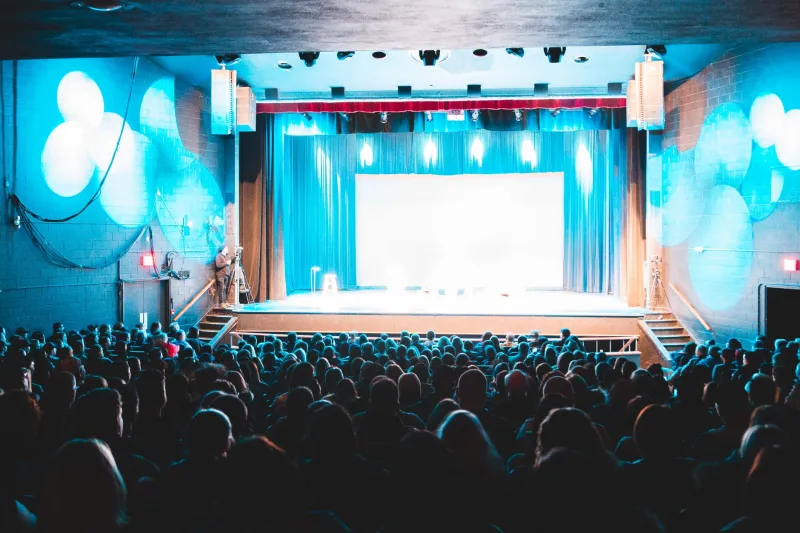
From the audience, a standing ovation looks like a wall of people. From the stage, it looks like something else. Under the lights, you can see silhouettes, the shine of phones, the gaps where people are still gathering their things. You can hear the difference between applause that is reluctant to stop and applause that is waiting for permission to end.
Performers are not fools. They know a polite standing ovation when they get one. They also know the real thing. A genuine ovation has weight. It has stamping and whooping and the strange, lovely refusal of an audience to let the moment go. An inflated ovation has a different texture: people are already reaching for their coats, checking the time, calculating the queue for the tube. The standing is happening, but the feeling has left the building.
I have sat in the wings and listened to both. The polite version is not nothing. It is kind. But it is not the same as the night the audience simply would not sit down. The difference is not volume. It is intention.
The quiet etiquette of staying seated
Here is the thing that gets lost in the ovation wars: staying seated is not an insult. It is an honest response. You can clap hard with your bottom on the seat. You can shout bravo from the stalls without rising. You can be deeply moved and still be aware that your knees are not what they were, or that the person behind you cannot stand, or that you simply do not feel like performing enthusiasm on cue.
Accessibility matters here. Not everyone can stand. Not everyone can stand quickly. Not everyone wants to stand in a cramped row while the person in front blocks the view of the curtain call. If we treat standing as the only valid way to show appreciation, we make a physical act the test of a feeling. That is unfair, and it is also a bit silly.
The quiet etiquette is simple: if you want to stand, stand. If you do not, do not. But do not spend the ovation looking around to see whether you are doing it right. The performers can tell the difference between a room that means it and a room that is going through the motions. They would rather have your honest applause than your reluctant knees.
Let applause mean something again
I am not against the standing ovation. I am against the default setting. I want the standing ovation to mean something. I want it to be the exception that proves the rule, not the rule that flattens everything into the same shape.
This matters most in a year like 2026, when theatres are still fighting for attention and every ticket feels like a small act of faith. Audiences are being asked to choose the live thing over the sofa, the stream, the scroll. That choice deserves respect. But it also deserves honesty. A standing ovation that happens because it is what we do now is not a gift to the performers. It is a fog.
The next time you are at a show and the person in front of you stands, you have options. You can stand too. You can stay seated and clap like you mean it. You can wait a beat and see what the room actually feels. All of those are fine. The only thing I would ask is that you do not make the ovation a reflex. Let it be a response. Let it be yours.
Because the best ovation I have ever heard was not the loudest. It was the one where nobody checked their watch.